Why Ayurveda Says Detox Is a Daily Function — Not a Retreat, Cleanse, or Crisis Response
Modern detox culture treats the body like a clogged drain. Ignore it for months, abuse it with stress and poor food choices, then panic and flush everything out with a juice cleanse, weekend retreat, or aggressive protocol.
Ayurveda calls that backward.
In classical Ayurvedic thinking, detoxification is not an event. It is a continuous, daily physiological function, just like breathing or circulation. When detox becomes something you “do once in a while,” it’s usually because the system failed to do it quietly every day.
Ayurveda doesn’t obsess over cleansing. It obsesses over why cleansing becomes necessary in the first place.
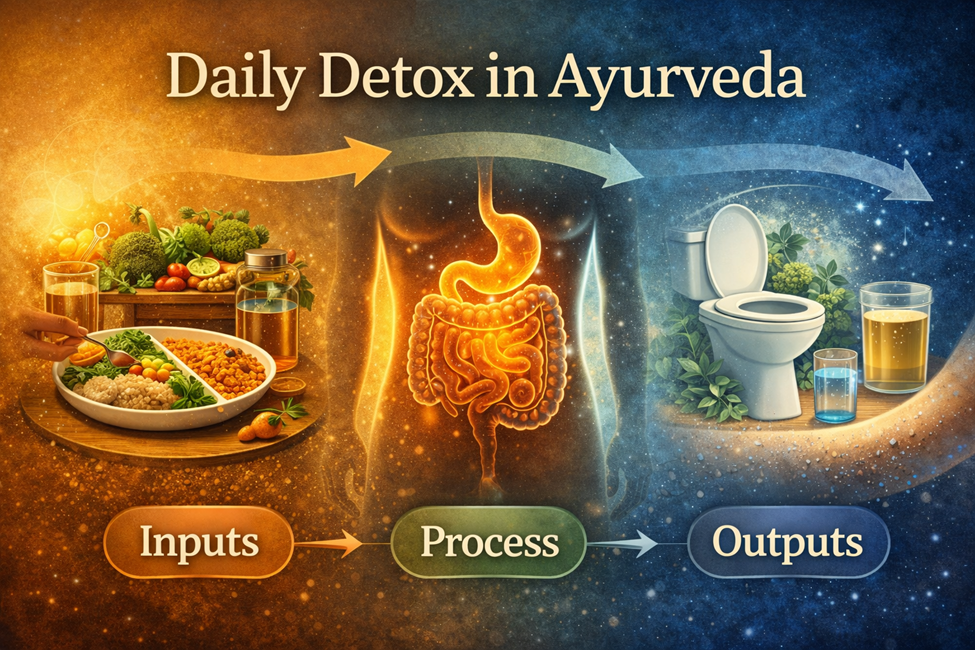
The Three-Part Model Ayurveda Uses (That Modern Detox Ignores)
Ayurveda evaluates detox through a simple but unforgiving lens:
- Inputs – what you put into the system
- Process – how well you digest and metabolize
- Outputs – how efficiently waste is eliminated
Most modern detox programs focus almost exclusively on #3. Ayurveda focuses primarily on #1 and #2—because if those are correct, #3 largely takes care of itself.
Let’s break that down.
See also: How to Leverage Tech for Better Decision-Making in Business
1. Inputs: You Can’t Out-Clean What You Keep Re-Ingesting
Ayurveda does not view food as neutral fuel. Every input carries qualities—heavy or light, heating or cooling, drying or oily, stabilizing or stimulating.
Daily detox begins with reducing the burden on the system.
That means:
- Eating foods appropriate to your constitution and season
- Avoiding incompatible combinations that confuse digestion
- Respecting timing (what works at noon may fail at night)
If inputs are mismatched, the body produces ama—a concept often oversimplified as “toxins,” but more accurately described as incompletely processed metabolic residue.
No amount of lemon water, activated charcoal, or retreat-level cleansing will fix daily overload.
Ayurveda’s stance is blunt:
If you’re constantly detoxing, your inputs are wrong.
2. Process: Digestion Is the Real Detox Organ
Modern health culture treats detox as something the liver does alone. Ayurveda treats digestion (agni) as the central intelligence governing detoxification.
Strong digestion:
- Breaks food down fully
- Absorbs what’s useful
- Flags waste early
- Prevents residue buildup
Weak or erratic digestion doesn’t just cause bloating—it creates systemic confusion. Nutrients aren’t fully assimilated, waste isn’t clearly separated, and the body starts storing what it doesn’t know how to process.
This is why Ayurveda prioritizes:
- Warm, cooked foods for many constitutions
- Spices as digestive regulators, not flavor
- Regular meal timing over constant snacking
Daily detox isn’t about “flushing.”
It’s about processing cleanly.
People who chase detox protocols often skip this step entirely—trying to clear waste that digestion never properly handled in the first place.
3. Outputs: Elimination Works Best When It’s Boring
Ayurveda assumes detox is working when elimination is:
- Regular
- Effortless
- Unremarkable
Daily bowel movements, clear urine, balanced perspiration, mental clarity—these are signs of ongoing detox, not heroic intervention.
When outputs become dramatic—sweats, purges, crashes—that’s usually correction, not maintenance.
Ayurveda does use deeper cleansing methods when needed, but only after inputs and digestion are stabilized. Otherwise, clearing without correction simply creates a cycle of buildup and purge.
That’s why detox retreats feel powerful but temporary.
They address outputs while daily habits quietly rebuild the problem.
Why Daily Detox Is Actually Less Extreme
Ironically, Ayurveda’s approach is less intense and more sustainable than modern detox culture.
Instead of:
- Occasional extremes
- Shock-based cleansing
- Willpower-driven restriction
It promotes:
- Daily alignment
- Digestive intelligence
- Small, consistent corrections
This is also why structured education matters. Understanding how inputs, digestion, and elimination interact gives people agency instead of dependency. That’s where CureNatural ayurveda classes fit naturally—not as lifestyle inspiration, but as practical training in how the body actually works.
And for people who want guidance without turning wellness into a second job, tools like CureNaturals’ ayurveda app can support daily awareness—helping users notice patterns, not chase fixes.
The Bottom Line Ayurveda Has Always Maintained
Detox is not something the body forgets how to do.
It’s something we overwhelm.
Ayurveda doesn’t ask, “How do we clean you out?”
It asks, “Why did your system stop clearing itself?”
When inputs are appropriate, digestion is strong, and elimination is regular, detox stops being dramatic—and starts being invisible.
Which, according to Ayurveda, is exactly how it’s supposed to be.